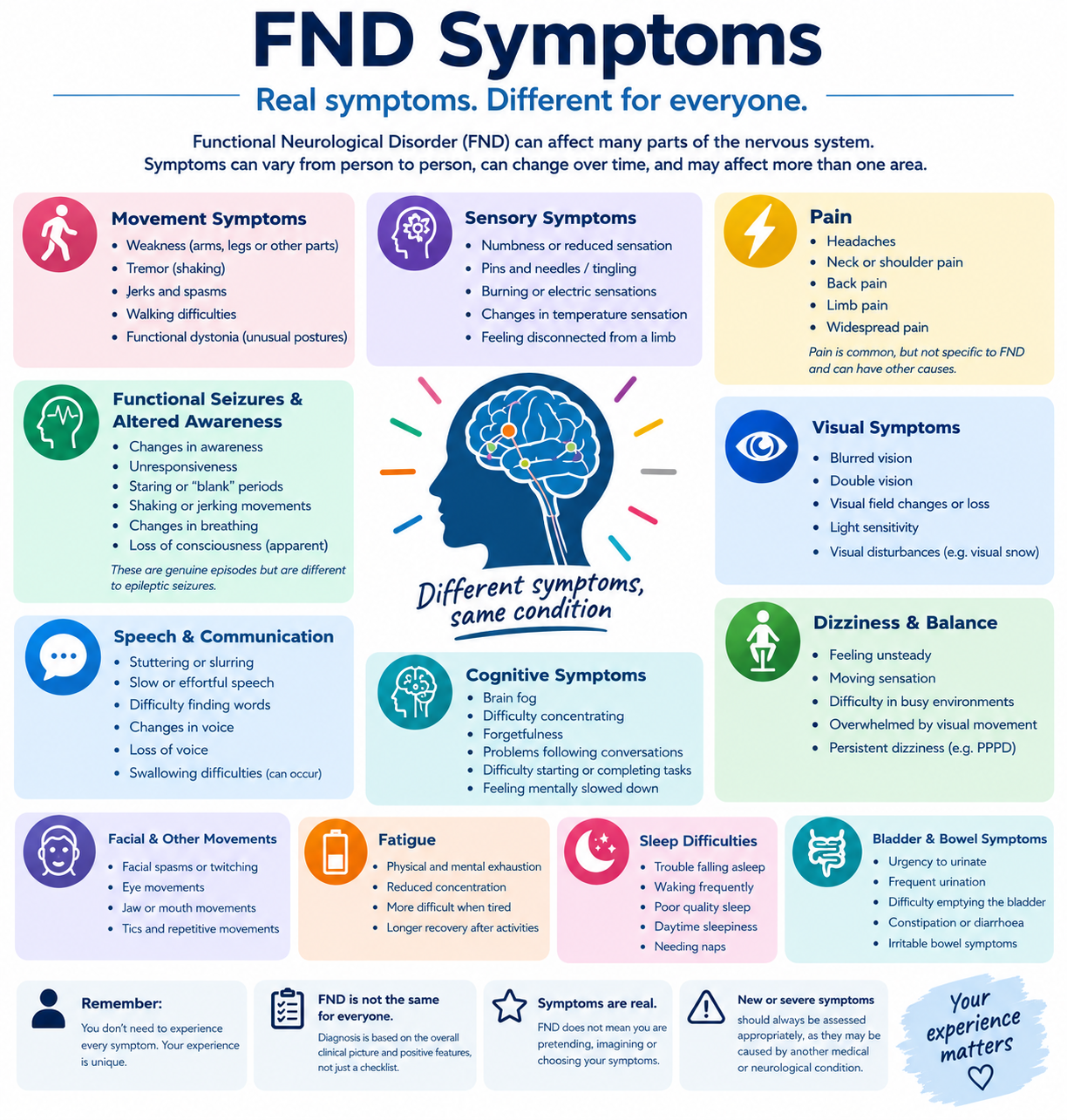
Understanding the Symptoms of FND
Functional Neurological Disorder (FND) can cause a wide range of neurological symptoms. These can affect movement, sensation, speech, vision, thinking, awareness and other functions of the nervous system.
One of the things that can make FND particularly difficult to understand is that there is no single set of symptoms that everyone with FND experiences.
One person may mainly experience weakness or difficulty walking. Another may experience tremor, spasms, sensory changes or functional seizures. Someone else may experience speech, cognitive or visual symptoms. Some people experience several different symptoms, and those symptoms can change over time.
FND symptoms are real and can be very disabling. They are associated with a problem in nervous system functioning, rather than being explained simply by structural damage to the nervous system.
Symptoms can be different from person to person
There is no requirement to have every symptom described below.
You may have one or several symptoms, and the combination can change over time. You may also have another neurological or medical condition alongside FND, so not every symptom a person experiences should automatically be assumed to be caused by FND.
This is one reason that an FND diagnosis should be made following an appropriate clinical assessment rather than by comparing your symptoms with a checklist.
Movement Symptoms
Movement symptoms are among the more commonly recognised features of FND.
They can include:
Weakness
Functional limb weakness can affect an arm, leg or other part of the body. A person may describe a limb as feeling weak, heavy, disconnected or difficult to control.
Weakness can affect walking, standing, reaching, gripping or other everyday activities.
Tremor
A tremor is an involuntary shaking movement. In FND, tremor can affect the hands, arms, legs, head or other parts of the body.
Jerks and spasms
Some people experience sudden involuntary movements or jerks. Others may experience sustained muscle contractions or spasms.
These can sometimes be described as functional jerks, spasms or functional dystonia, depending on the type of movement.
Walking difficulties
FND can affect the way someone walks. A person may experience difficulty initiating movement, changes in their walking pattern, instability, dragging of a foot or episodes where their legs feel as though they will not move.
Functional gait symptoms can sometimes be particularly confusing because the person's ability to move can vary depending on the circumstances.
Functional dystonia
Dystonia involves abnormal muscle contractions that can cause unusual or sustained postures.
In FND, this can include a hand becoming clenched or a foot turning inward, although presentations vary considerably.
Sensory Symptoms
FND can affect the way sensory information is experienced and processed.
Sensory symptoms can include:
-
Numbness
-
Reduced sensation
-
Pins and needles
-
Tingling
-
Burning sensations
-
Electric or buzzing sensations
-
Altered temperature sensation
-
Changes in how touch is experienced
-
Changes in the sensation of a limb or part of the body
Some people describe a limb or area of their body as feeling different, strange, disconnected or as though it does not belong to them.
Sensory symptoms can affect one part of the body, one side of the body, or other patterns. The pattern can sometimes be quite different from what would be expected from damage to a particular nerve or part of the nervous system.
Pain
Pain is very common in people with FND.
It may include:
-
Headaches
-
Neck or shoulder pain
-
Back pain
-
Limb pain
-
Widespread pain
-
Burning or electric sensations
-
Muscle or joint pain
However, pain is not specific to FND and can have many different causes. Chronic pain may occur alongside FND rather than necessarily being caused by FND itself.
Functional Seizures and Episodes of Altered Awareness
Some people with FND experience functional seizures, sometimes called dissociative seizures.
These are genuine episodes that can involve changes in movement, awareness or responsiveness. They can look similar to epileptic seizures, but they have a different underlying mechanism.
Functional seizures can involve:
-
Changes in awareness
-
Becoming unresponsive
-
Staring or appearing "blank"
-
Falling
-
Shaking or jerking movements
-
Changes in breathing
-
Prolonged or unusual movements
-
Episodes of apparent loss of consciousness
Some people experience functional seizures with prominent movements, while others may become still or unresponsive.
It is important not to try to diagnose a seizure from a checklist of symptoms. Functional seizures and epilepsy are different conditions, although a person can have both, and diagnosis requires appropriate medical assessment.
Speech and Communication Symptoms
FND can affect speech and communication.
Symptoms can include:
-
Stuttering
-
Slurring
-
Slow or effortful speech
-
Difficulty getting words out
-
Difficulty finding words
-
Changes in voice
-
Whispering or very quiet speech
-
Loss of voice
-
Changes in pitch or volume
Speech symptoms can fluctuate, sometimes considerably.
Some people may find that their speech becomes more difficult when they are tired, under pressure or dealing with increased symptoms, although individual experiences vary.
FND can also involve swallowing difficulties, although these should always be appropriately assessed because swallowing problems can have many causes.
Cognitive Symptoms
FND can be associated with difficulties involving thinking and attention.
People may describe:
-
Brain fog
-
Difficulty concentrating
-
Forgetfulness
-
Difficulty finding information
-
Problems following conversations
-
Difficulty starting or completing tasks
-
Feeling mentally slowed down
-
Difficulty switching between tasks
-
Feeling overwhelmed by too much information
These symptoms can be particularly frustrating because they may not be obvious to other people.
Someone may look as though they are functioning normally while having to put considerably more effort into processing information.
Visual Symptoms
FND can also affect vision.
Possible functional visual symptoms include:
-
Blurred vision
-
Double vision
-
Visual field changes or loss
-
Light sensitivity
-
Visual disturbances such as visual snow
Visual symptoms can be frightening, particularly when they appear suddenly.
As with other neurological symptoms, new or unexplained visual changes should be assessed appropriately rather than automatically assumed to be FND.
Dizziness and Balance
Some people with FND experience dizziness or difficulties with balance.
This can include:
-
Feeling unsteady
-
Feeling as though the environment is moving
-
Difficulty walking in busy environments
-
Feeling overwhelmed by visual movement
-
Persistent dizziness
Persistent Postural-Perceptual Dizziness (PPPD) is a recognised functional dizziness condition and can occur within the spectrum of functional neurological disorders.
Facial and Other Functional Movements
FND can sometimes affect movements of the face.
These can include:
-
Facial spasms
-
Eye movements
-
Facial twitching
-
Jaw or mouth movements
-
Other involuntary facial movements
Functional tics and other repetitive movements can also occur.
Fatigue
Fatigue is very commonly reported by people with FND.
This can be more than simply feeling sleepy.
Someone may experience:
-
Physical exhaustion
-
Mental exhaustion
-
Difficulty concentrating when tired
-
Reduced ability to cope with sensory information
-
Needing longer recovery after activities
-
Symptoms becoming more difficult to manage when fatigued
Fatigue is commonly associated with FND, but it is also a symptom of many other conditions. It therefore shouldn't automatically be assumed to be caused by FND.
Headaches and Migraine
Headaches and migraine can occur alongside FND.
Some people experience:
-
Tension-type headaches
-
Migraine
-
Frequent headaches
-
Head pressure
-
Head and neck pain
Again, headaches are not specific to FND and may have another cause or occur as a separate condition.
Sleep Difficulties
Sleep problems are also commonly reported alongside FND.
These can include:
-
Difficulty falling asleep
-
Difficulty staying asleep
-
Poor-quality sleep
-
Waking frequently
-
Excessive daytime sleepiness
-
Needing daytime naps
Poor sleep can also affect fatigue, concentration and the ability to cope with other symptoms, which can make the overall picture more complicated.
Bladder and Bowel Symptoms
Some people with FND experience bladder or bowel symptoms.
These may include:
-
Urgency to urinate
-
Frequent urination
-
Difficulty emptying the bladder
-
Constipation
-
Diarrhoea
-
Irritable bowel symptoms
These symptoms have many possible causes and should not automatically be attributed to FND. Appropriate assessment is particularly important for new bladder or bowel problems.
Symptoms Can Change
One of the most important things to understand about FND is that symptoms can fluctuate.
You might experience one symptom more strongly one day and another symptom on a different day.
For example:
Monday:
Walking is particularly difficult.
Tuesday:
Walking is easier, but concentration and speech are more difficult.
Wednesday:
Tremor and fatigue become more noticeable.
This does not mean that the symptoms are imaginary or that the person is deliberately controlling them.
Functional neurological symptoms can fluctuate and can change over time.
FND Is Not the Same for Everyone
It can be tempting to look at a long list of FND symptoms and think:
"I don't have all of those, so perhaps I don't have FND."
That isn't how FND works.
There is no requirement to experience every symptom.
Likewise, having a symptom on a list does not mean that the symptom is necessarily caused by FND.
FND is diagnosed through the overall clinical picture and positive clinical features identified by an appropriately trained healthcare professional, rather than simply because investigations have failed to find another explanation.
This distinction is important.
Symptoms Are Real
Perhaps the most important message is that functional neurological symptoms are real symptoms.
FND does not mean that someone is pretending, imagining their symptoms or consciously choosing to experience them.
The problem is with how the nervous system is functioning and processing information. This can produce genuine changes in movement, sensation, speech, cognition and awareness.
A Final Word About New Symptoms
If you already have an FND diagnosis, it can be tempting to assume that every new neurological symptom is simply another FND symptom.
It is important not to do this.
New, sudden, severe or significantly different neurological symptoms should be assessed appropriately, particularly symptoms such as sudden weakness, loss of vision, difficulty speaking, severe headache, loss of consciousness or other symptoms that could indicate another medical or neurological problem.
Having FND does not prevent someone from developing another medical or neurological condition.
Understanding Your Own Symptoms
Keeping a FND: Symptom and Activity Diary can help you understand how your symptoms change and how they relate to your daily life.
Recording what you were doing, your sensory environment, rest, sleep and symptoms over time can help you and your healthcare team identify patterns.
It can also help you recognise that FND symptoms aren't necessarily static.
What you experience today may not be exactly what you experience next week — and that variability is part of the experience of FND for many people.
Most importantly, you do not need to experience every symptom described here. FND affects people differently, and your experience is your own.