
Living With FND: Support, Self-Management and Our Surrey FND Support Group
Being diagnosed with Functional Neurological Disorder (FND) can bring a mixture of emotions. Getting that diagnosis can also be challenging for some people across the country.
For some people, finally having a name for their symptoms can be a relief. For others, it can leave them with more questions than answers.
What happens next?
What can I do to help myself?
Will I get better?
Who can I talk to who actually understands what living with FND is like?
There is no single answer to these questions because everyone's experience of FND is different. However, there are things that can help, and having the right support around you can make a real difference.
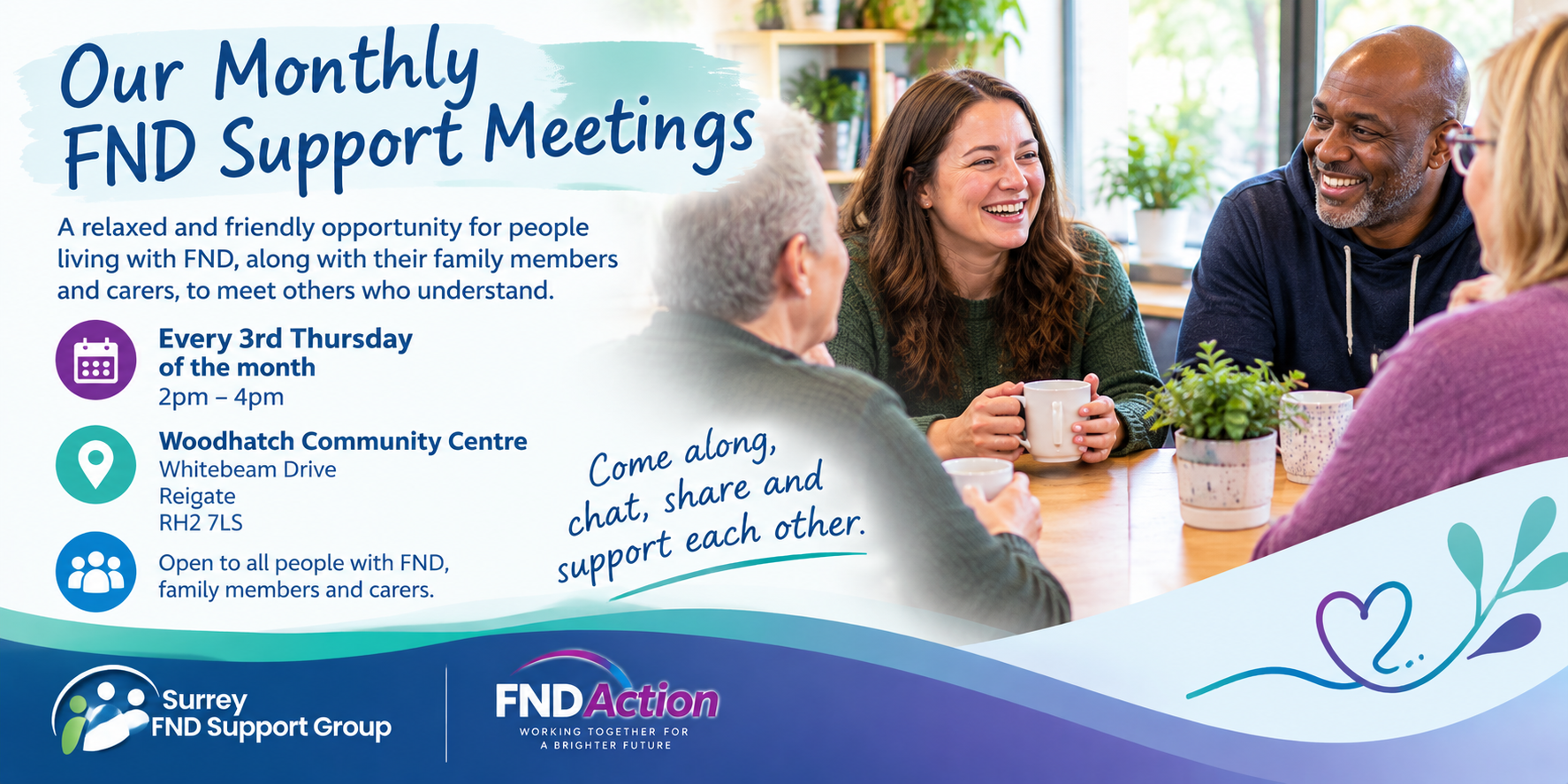
Our Surrey FND Support Group has been established with FND Action to provide a friendly local place where people affected by FND can meet others, share experiences and support one another.
You don't have to manage FND on your own
FND can sometimes be an isolating condition.
Symptoms such as weakness, tremor, seizures, fatigue, pain, problems with movement or difficulties with concentration can be difficult for other people to understand. Symptoms can also fluctuate, meaning that what someone can do one day may be very different from what they can manage the next.
That can be frustrating for the person with FND and for the people around them.
Meeting other people who understand some of these experiences can be enormously valuable.
A support group isn't a replacement for medical care, but it can provide something different: peer support from people who understand what it is like to live with FND.
FND Action describes its community groups as places where people can connect, share experiences, build friendships and find practical information and encouragement. Their groups are also open to carers, family members and people supporting someone with FND.
What can help with FND?
There isn't one treatment that works for everyone with FND.
Treatment and rehabilitation should be based on the individual's symptoms, needs and goals. FND Action recommends a personalised approach which may involve a number of different healthcare professionals depending on someone's symptoms.
This can include:
Physiotherapy and movement retraining
For people experiencing functional weakness, tremor, abnormal movements or walking difficulties, specialist physiotherapy can be an important part of treatment.
Rather than simply trying to strengthen a weak muscle, FND physiotherapy may concentrate on retraining movement and helping the brain and body establish more normal movement patterns.
The approach needs to be appropriate for the individual. Pushing through symptoms or dramatically increasing activity is not necessarily the answer.
Occupational therapy
Occupational therapists can help people find ways of managing everyday activities and improving independence.
This might include looking at:
-
Managing fatigue
-
Balancing activity and rest
-
Everyday tasks
-
Returning to work or education
-
Establishing routines
-
Managing pain
-
Finding practical ways to maintain independence
Self-management is an important part of occupational therapy for FND.
Managing fatigue and pacing
Fatigue is a common and often underestimated problem for people living with FND.
It can be tempting to try to do everything on a "good day", only to find that the following day becomes much more difficult.
Learning to recognise your limits and finding a balance between activity and rest can be helpful.
Pacing isn't about giving up activities. It is about finding a sustainable level of activity and gradually working towards your goals without repeatedly pushing yourself into a significant flare-up.
What works for one person may not work for another, so pacing should be individualised.
Understanding your FND
Understanding what FND is and why symptoms happen can itself be an important part of treatment.
A clear explanation of the diagnosis can help people understand that their symptoms are real and involuntary, while also providing a framework for understanding why symptoms may change.
Learning about FND from reliable sources can also help people have more productive conversations with healthcare professionals and family members.
FND Action recommends using trusted sources of information because there is a great deal of inaccurate or outdated information about FND online.
Looking after your overall wellbeing
Living with a long-term neurological condition can affect much more than physical symptoms.
Sleep, stress, relationships, work, finances, social activities and mental wellbeing can all be affected.
Looking after these areas doesn't mean that FND is "all in your head". Mental wellbeing is simply one part of looking after the whole person.
For some people, psychological support may form part of their FND treatment. This doesn't mean that their neurological symptoms aren't real. Instead, it can provide additional tools for dealing with the impact of living with a complex condition.
FND Action also highlights basic self-care, safe movement within individual limits, sleep routines, nutrition and talking to people you trust as potentially helpful parts of looking after yourself.
Small improvements matter
Living with FND can sometimes make people focus on what they can no longer do.
It can be helpful to recognise the things you can do and the progress you make, even when that progress seems small.
Improvement doesn't necessarily mean that every symptom disappears.
For one person, improvement might mean being able to walk a little further.
For another, it might mean having fewer episodes, being able to leave the house more often, returning to a hobby, getting better sleep or simply feeling more confident managing their symptoms.
FND Action describes improvement as different for everyone and notes that it may involve fewer symptoms, better control or an improved quality of life rather than necessarily a complete return to how things were before.
The value of talking to other people with FND
One of the most important things a support group can provide is something that is difficult to obtain from a medical appointment: time to talk to people who have lived experience of FND.
You may find that someone else has experienced a symptom that you thought nobody else understood.
Someone might have discovered a practical way of making an everyday activity easier.
Someone else may simply understand why you had to cancel plans at the last minute.
There is no expectation that everyone will have the same experience. FND affects people in many different ways.
Our group is about sharing experiences rather than telling other people what they "should" do.
What helps one person may not help another, and experiences shared within the group should not be regarded as medical advice.
Our Surrey FND Support Group
Our Surrey group is run in partnership with FND Action, a UK charity dedicated to supporting people affected by Functional Neurological Disorder.
The group provides a local opportunity to meet other people affected by FND in a relaxed and supportive environment.
When do we meet?
Third Thursday of every month
2pm – 4pm
Where?
Woodhatch Community Centre
Whitebeam Drive
Reigate
RH2 7LS
The group is open to:
-
People living with FND
-
People who have recently been diagnosed
-
People who have been living with FND for many years
-
Family members
-
Carers
-
People supporting someone with FND
You don't need to be an expert on FND, and you don't need to prepare anything before coming along.
You can simply come along, have a cup of tea and meet people.
FND Action's regional community groups are specifically intended to provide opportunities for people to connect locally, with activities varying between regions. The Surrey group is currently listed as meeting in person at Woodhatch Community Centre on the third Thursday of each month.
What happens at a meeting?
There isn't a test and there isn't a requirement to speak.
Some people may want to talk about their experiences. Others may prefer to listen.
We can talk about things such as:
-
Living with FND day to day
-
Managing symptoms
-
Dealing with fatigue
-
Getting the right support
-
Experiences with healthcare
-
Useful resources
-
Practical adaptations
-
The challenges faced by family and carers
-
Things that have helped us
-
Things we have learned along the way
But the meeting doesn't have to be all about FND.
Sometimes it's simply nice to spend time with people who understand.
FND might be what brings us together, but it doesn't have to be what we talk about all afternoon.
A safe and supportive environment
Everyone's experience of FND is different, and we want our group to be a place where people feel comfortable being themselves.
We encourage members to listen to one another, respect different experiences and avoid judging someone else's symptoms or treatment choices.
The group isn't intended to replace medical advice. If you have concerns about your symptoms, treatment or medication, you should discuss them with your GP, neurologist or appropriate healthcare professional.
Instead, the group provides an additional source of peer support, understanding and friendship.
You're welcome
Whether you've just received an FND diagnosis or you've been living with the condition for years, you are welcome to come along.
You don't have to be having a good day.
You don't have to be able to walk unaided.
You don't have to know anyone beforehand.
And you don't have to talk if you don't want to.
Just come along when you're able.
Surrey FND Support Group
Third Thursday of every month
2pm – 4pm
Woodhatch Community Centre, Reigate
Our group is part of the wider FND Action community, helping people affected by FND to connect with others and find reliable information and support.
You are not alone with FND.