
Understanding Your “Jug of Tolerance”
When we talk about triggers in FND, one useful way of understanding them is through the “Jug of Tolerance” analogy.
Imagine that everyone has an invisible jug. This jug represents our general well-being, available resources and ability to cope with everything that is happening around us.
Every day, our brains and bodies have to deal with lots of different demands. Some are small and barely noticeable, while others can require a great deal of energy.
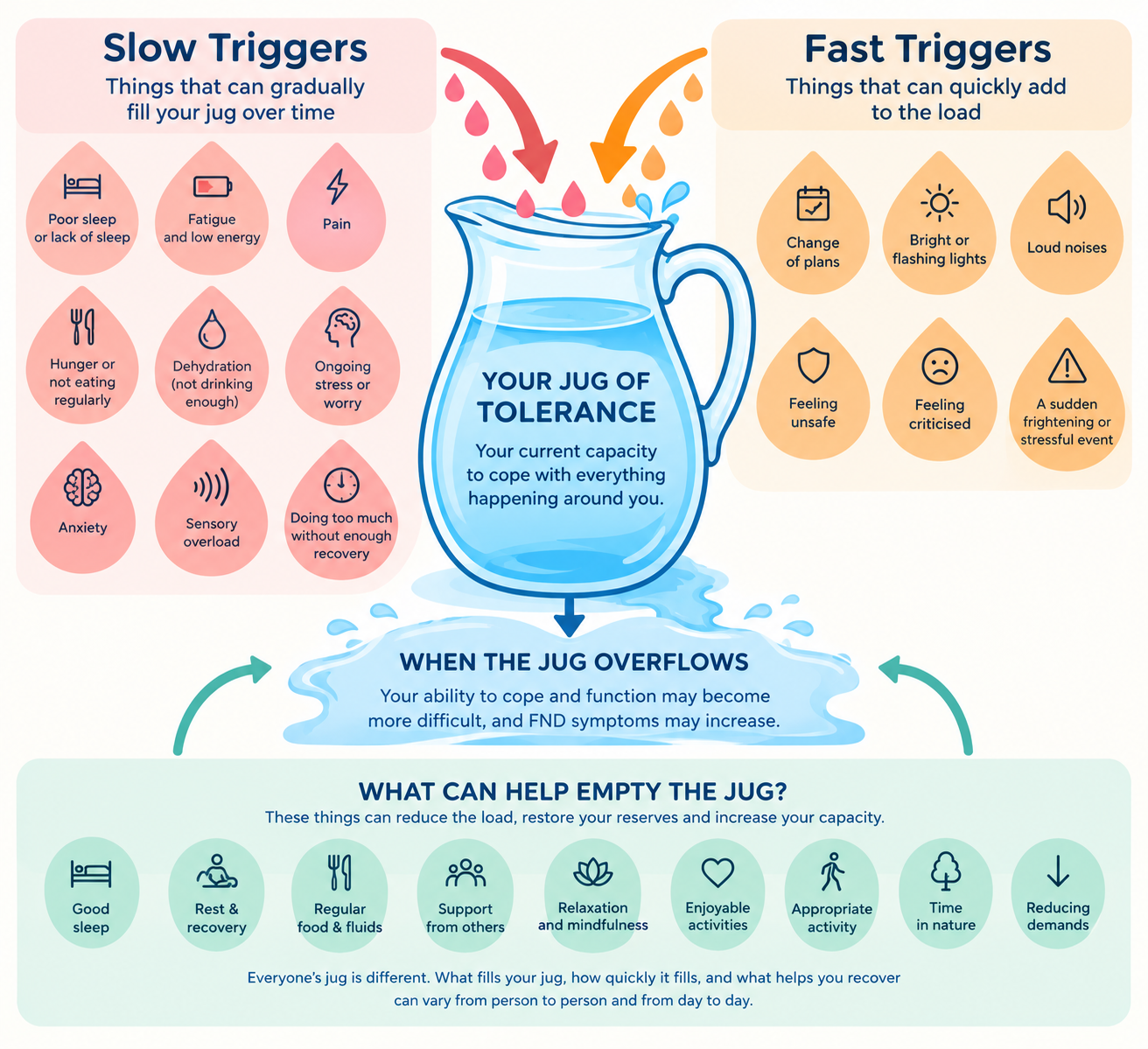
What fills your jug?
Many things can add to what your brain and body have to cope with. These can include:
- Pain
- Poor or disrupted sleep
- Feeling tired or exhausted
- Hunger or dehydration
- Stress or worry
- Anxiety
- Sensory overload
- Bright or flashing lights
- Loud or unexpected noises
- Changes to plans or routines
- Feeling unsafe
- Arguments or conflict
- Feeling criticised or under pressure
- Illness
- Work or family pressures
- Having too many things to think about at once
Some of these things might seem quite small on their own. However, they can add up.
For example, imagine that you have had a poor night's sleep. You wake up tired, haven't had time for breakfast, and are already dealing with some pain. Later in the day, your plans suddenly change, and you find yourself somewhere noisy and busy.
None of these things might be enough to overwhelm you on their own. But when you add them together, your jug can gradually fill up.
Everyone's jug is different
An important part of the analogy is that everyone's jug is different.
What one person can cope with comfortably may be much harder for another. Even for the same person, the size of their jug can seem to change from day to day. (Even the author of this has noticed this and notes it can be very challenging to manage)
On a day when you have slept well, feel rested and have fewer demands on you, your capacity to deal with additional stress may be greater.
On another day, perhaps after several nights of poor sleep, increased pain or a particularly stressful period, your jug may already be close to full.
This is why something that normally wouldn't bother you can sometimes have a much greater effect.
It doesn't mean that you are weaker. It means that your jug was already fuller.
Triggers can be the final drop
A trigger isn't necessarily what caused everything that came before it.
Think about a jug that is almost completely full. If one more drop goes in, the jug may overflow.
That final drop might be something relatively minor — perhaps a change of plans, a loud noise, a difficult conversation or becoming overwhelmed in a busy environment.
It would be easy to look at that final event and think:
“That caused my symptoms.”
But many other things may have already filled the jug beforehand.
This can help explain why the same situation can affect you differently at different times.
What happens when the jug overflows?
When the demands placed on us exceed our available capacity to cope, we may find it harder to function.
For someone with FND, this may be accompanied by an increase or change in symptoms.
Depending on the person, this could include things such as increased tremor, weakness, abnormal movements, speech difficulties, sensory symptoms, dissociation, fatigue or other FND symptoms.
This doesn't mean that the symptoms are imagined or that someone is consciously producing them.
The symptoms are real!
The Jug of Tolerance is a way to help us understand how different demands on the brain and nervous system can build up, and why symptoms may sometimes become harder to manage.
Your jug can also be topped up
The analogy isn't just about what fills your jug.
There are also things that can help you recover, recharge and increase your available capacity.
These might include:
- Getting enough sleep and allowing time for rest
- Eating regularly and keeping hydrated
- Taking breaks before you become completely exhausted
- Spending time doing things you enjoy
- Connecting with people who make you feel safe and supported
- Reducing unnecessary sensory stimulation
- Spending time outdoors or in nature
- Gentle activity where appropriate
- Having periods of quiet and relaxation
- Giving yourself time to recover after particularly demanding situations
- Learning what situations tend to increase your symptoms
- Asking for help when you need it
These things don't necessarily make the triggers disappear. Instead, they may help prevent your jug from becoming completely full.
You don't have to avoid every trigger
Don't interpret the Jug of Tolerance as meaning you need to avoid everything that might increase your stress.
That would be impossible — and trying to avoid every possible trigger could itself become stressful.
The aim is to become more aware of what is filling your jug, recognise when it is getting close to overflowing, and where possible give yourself opportunities to recover.
Sometimes the most useful question isn't:
“What triggered my symptoms?”
but:
“What was already in my jug before this happened?”
That small shift in perspective can help.
A symptom flare may not have one single cause. It may result from several things building up over hours, days, or even longer.
There is no blame
Most importantly, the Jug of Tolerance is not about blaming yourself.
You cannot always control your circumstances, and you cannot always prevent your jug from becoming full. Pain, illness, poor sleep, unexpected events and other stresses are sometimes unavoidable.
Having symptoms does not mean that you have failed to cope.
Think of the jug as a way to understand your nervous system rather than judge yourself.
Your jug will be different from someone else's, and it may change from day to day.
Learning to recognise what fills your jug, what helps to empty it, and when you might need additional support can be one useful part of understanding and managing life with FND.