
The Fight or Flight Response and FND
In FND, we know that messages and signals are not always being sent, received or processed correctly within the brain. This can affect how the brain and body communicate and can contribute to many FND symptoms.
One particularly important system is the fight-or-flight response.
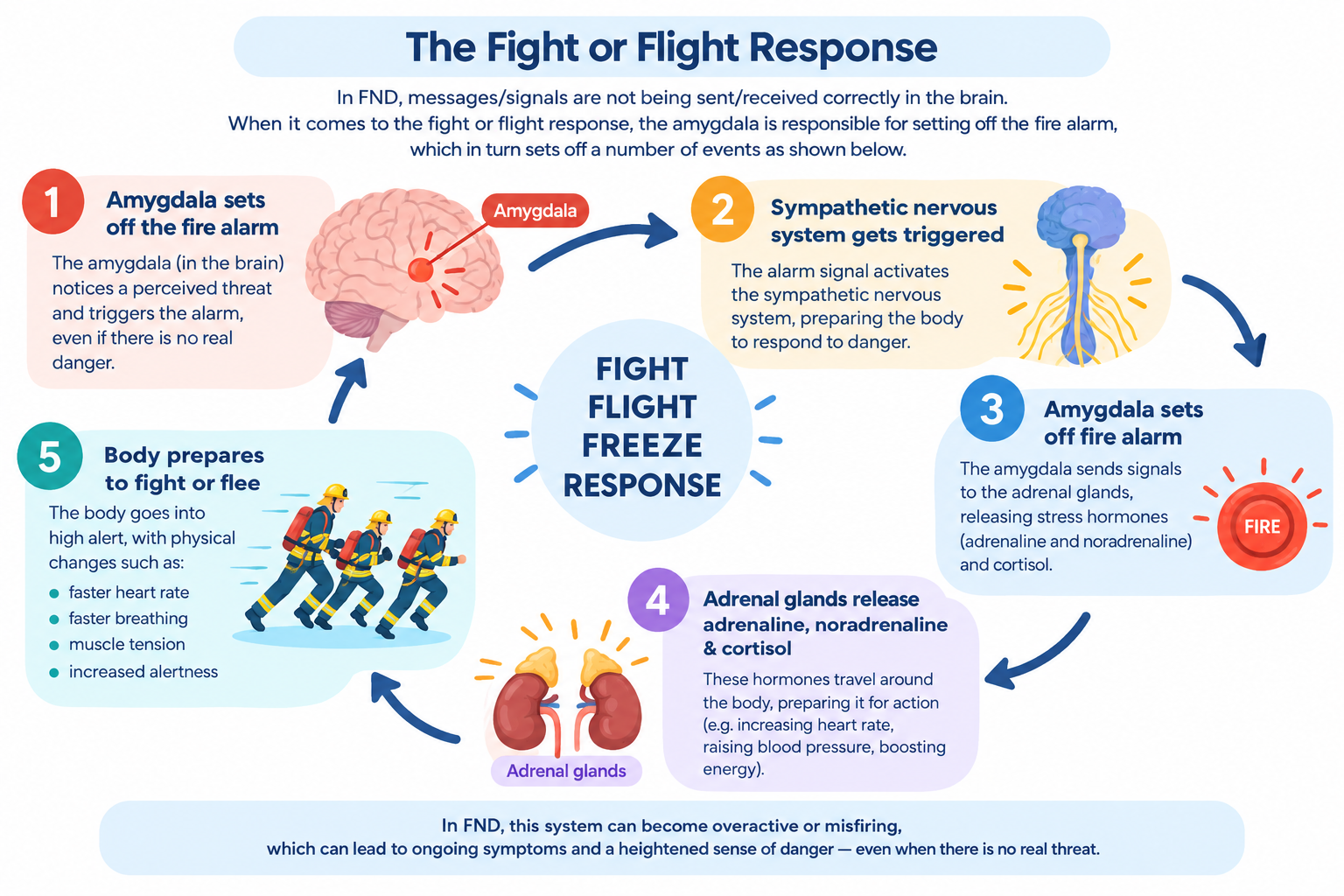
The fight-or-flight response is the body's natural emergency system. It is designed to protect us when the brain detects something that it believes could be dangerous. This could be a physical threat, but it can also be triggered by things such as stress, fear, pain, worry, sensory overload or other situations that the brain interprets as threatening.
A small part of the brain called the amygdala plays an important role in this process. You can think of the amygdala as being a little like the brain's fire alarm.
When the alarm is triggered, the body can rapidly prepare itself to deal with a perceived threat. The brain sends signals to other parts of the nervous system, which can lead to a number of changes throughout the body.
These can include:
-
An increased heart rate, helping prepare the body for action.
-
Faster or shallower breathing.
-
Increased muscle tension, as the body prepares to move.
-
Changes in blood flow and blood pressure.
-
Increased alertness and awareness of what is happening around you.
-
The release of stress hormones such as adrenaline and cortisol.
-
Changes to digestion, because digestion is temporarily less important when the body believes it needs to deal with a threat.
-
Increased sweating or changes in body temperature.
All of this is completely normal. The fight-or-flight response is something everyone has, and it can be extremely useful when there is a genuine danger.
So what does this have to do with FND?
For someone with FND, the problem is not that the fight-or-flight response itself is broken. Rather, the brain's processing and response to signals can become altered.
The brain does not always need a physical danger to activate its alarm system. Stress, pain, fatigue, anxiety, sensory overload, illness or a previous difficult experience can sometimes be enough for the nervous system to move into a heightened state of alert.
For some people with FND, the nervous system can become more sensitive to these signals, meaning that it may respond more strongly or more quickly to things such as stress, pain, fatigue, anxiety or sensory overload. This can mean that a level of stress or stimulation that might be manageable for one person can contribute to an increase in symptoms for someone with FND.
This does not mean that everyone with FND is constantly in a state of fight, flight or freeze, and FND symptoms can occur even when someone feels calm or relaxed. Rather, it is one way of understanding why symptoms may sometimes become worse when the nervous system is under increased demand.
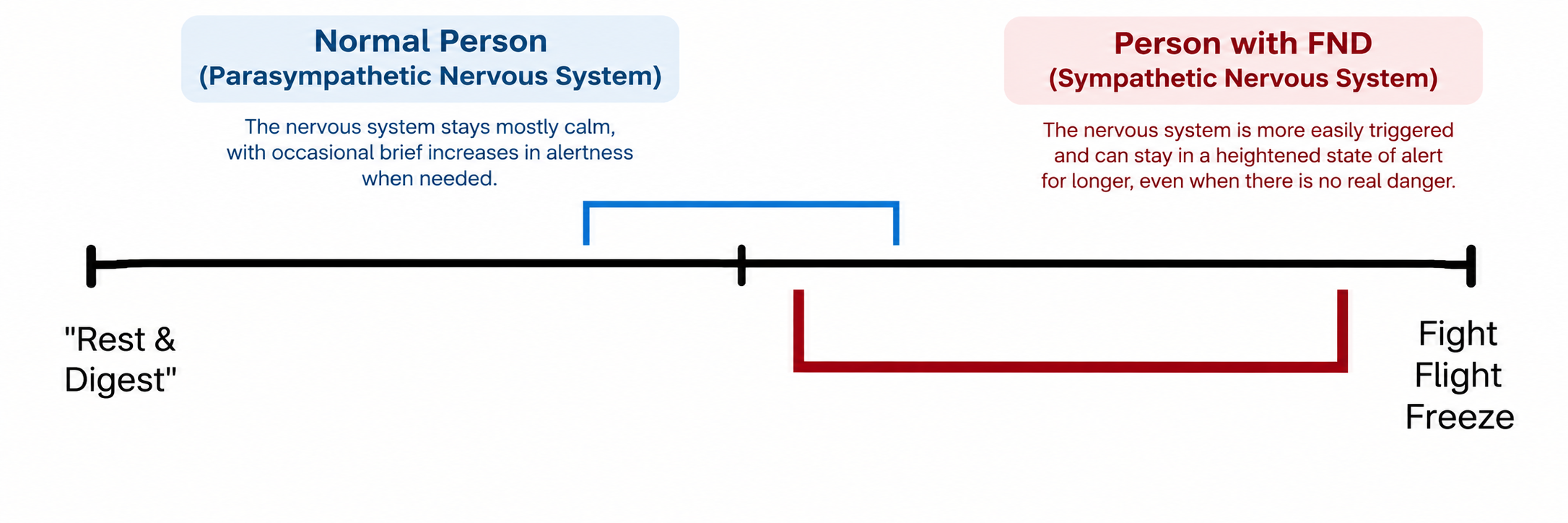
Once this happens, the body can remain on high alert even when there is no immediate danger.
This can create a cycle:
Something is perceived as a threat → the brain activates the alarm → the body responds → symptoms can increase → the symptoms themselves can become frightening → the brain perceives more threat → the alarm becomes more active.
This does not mean that FND symptoms are imagined or that someone is simply "stressed". The symptoms are real. The brain and nervous system are producing real physical changes, and the person experiencing them has no more control over this than someone has over their heart beating faster when they are frightened.
The alarm can become too sensitive
It can be helpful to imagine a fire alarm that has become overly sensitive.
A normal fire alarm should go off when there is a fire. But imagine one that also goes off when you make toast, take a shower or create a little steam.
The alarm itself is working — it is simply responding to signals that do not require the same level of emergency response.
The nervous system can sometimes behave in a similar way. It may react strongly to signals that would not normally require such a powerful response.
This is one reason why symptoms can fluctuate. Someone may feel relatively well at one point and then experience a significant increase in symptoms after becoming tired, overwhelmed, stressed, frightened or unwell.
It is also why symptoms can sometimes appear to have no obvious trigger. The brain is constantly processing an enormous amount of information, and not every trigger will be obvious or consciously recognised.
It is not your fault
Understanding the fight-or-flight response is not about blaming someone for their symptoms.
Having FND does not mean that you are choosing to be stressed, anxious or frightened. It does not mean that your symptoms are "all in your head", and it does not mean that you can simply relax and make them disappear.
The brain is an incredibly complicated organ, and the way it processes information can change for many different reasons.
For some people, understanding this process can nevertheless be useful. It can help explain why symptoms sometimes worsen during periods of increased pressure, tiredness, or sensory overload, and why giving the nervous system opportunities to settle may sometimes help.
The aim is not to constantly monitor yourself for signs of stress or to worry about whether you are triggering your symptoms. That can itself become another source of pressure.
Instead, it can help to think of the nervous system as something that sometimes needs time, safety, and reduced demands to move out of its heightened state.
Most importantly, experiencing FND symptoms is not your fault. Your symptoms are real, and understanding how the brain and nervous system communicate is simply one part of understanding FND.