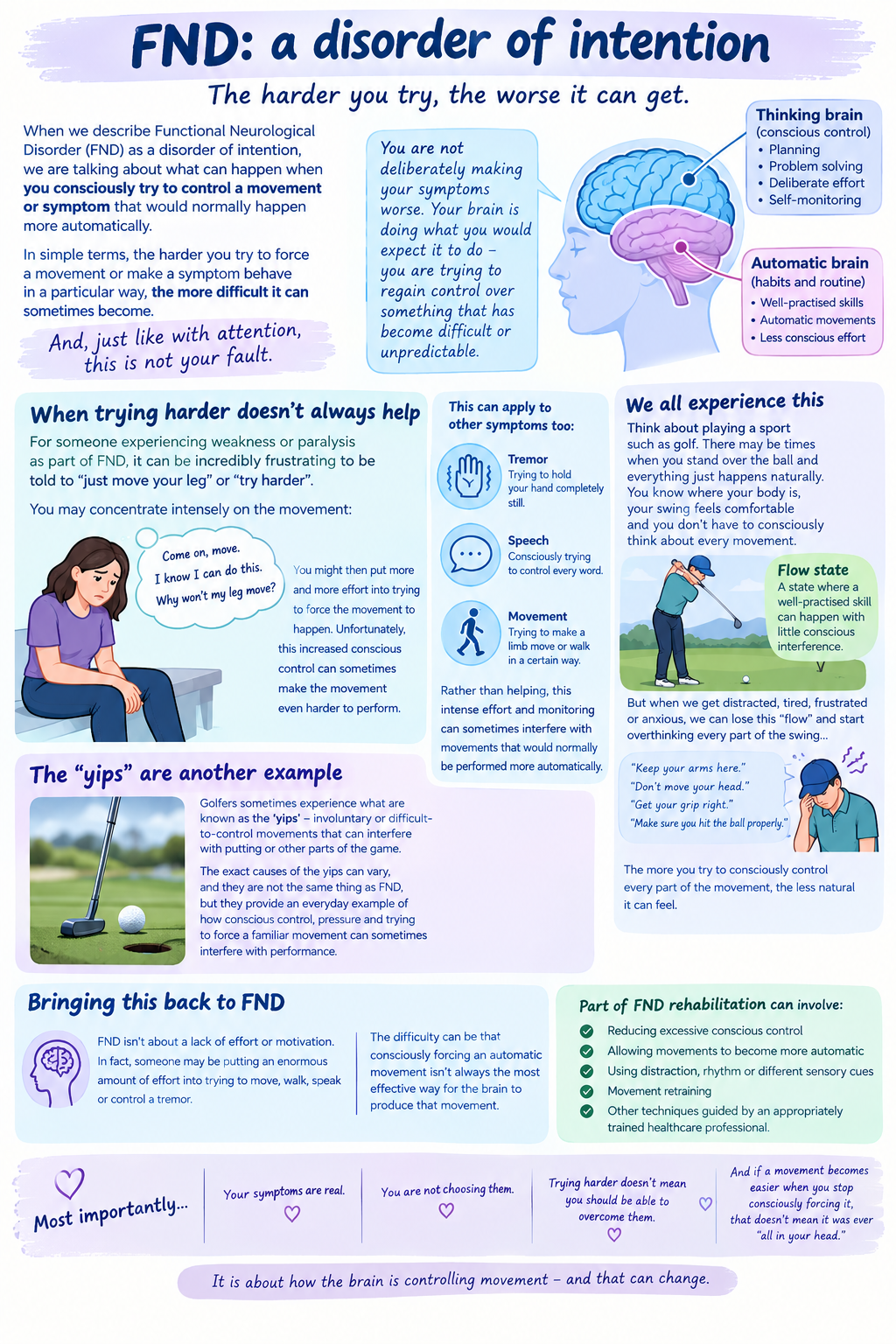
When we describe Functional Neurological Disorder (FND) as involving a “disorder of intention,” we are talking about what can happen when you consciously try to control a movement or symptom that would normally happen more automatically.
In simple terms, the harder you try to force a movement or make a symptom behave in a particular way, the more difficult the movement can sometimes become.
And, just like with attention, this is not your fault. You are not deliberately making your symptoms worse. In fact, your brain is doing what you would expect—you are trying to regain control over something that has become difficult or unpredictable.
When trying harder doesn't always help
For someone experiencing weakness or paralysis as part of FND, it can be incredibly frustrating to be told to “just move your leg” or “try harder.”
You may concentrate intensely on the movement:
“Come on, move.”
“I know I can do this.”
“Why won't my leg move?”
You might then put more and more effort into trying to force the movement to happen. Unfortunately, this increased conscious control can sometimes make the movement even harder to perform.
The same principle can apply to other symptoms. Someone experiencing a tremor may try desperately to hold their hand completely still. Someone experiencing speech difficulties may consciously try to control every word. Rather than helping, this intense effort and monitoring can sometimes interfere with movements that would normally be performed more automatically.
We all experience this
Although this can be particularly noticeable in FND, the basic principle of overthinking or consciously controlling a well-practised skill is something many of us experience.
Think about playing a sport such as golf.
There may be times when you stand over the ball, and everything seems to happen naturally. You know where your body is, your swing feels comfortable, and you don't have to consciously think about every individual movement.
You are simply doing it.
This is sometimes described as being in a “flow” state—where a well-practised skill can happen with relatively little conscious interference.
But then something changes. Perhaps you become tired, distracted, frustrated or anxious about your performance. Suddenly, you start thinking about every part of your swing:
“Keep your arms here.”
“Don't move your head.”
“Get your grip right.”
“Make sure you hit the ball properly.”
The more you try to consciously control every part of the movement, the less natural it can feel.
The “yips” are another example
Golfers sometimes experience what are known as the “yips”—involuntary or difficult-to-control movements that can interfere with putting or other parts of the game. The exact causes of the yips can vary, and they are not the same thing as FND, but they provide an everyday example of how conscious control, pressure and trying to force a familiar movement can sometimes interfere with performance.
The golfer may know exactly what they want their body to do, but the movement suddenly doesn't happen the way they expect. Trying even harder can then increase frustration and make the situation feel even more difficult.
Bringing this back to FND
This helps us understand why “just try harder” isn't necessarily helpful for someone with FND.
FND isn't about a lack of effort or motivation. In fact, someone may be putting an enormous amount of effort into trying to move, walk, speak or control a tremor.
The difficulty can be that consciously forcing an automatic movement isn't always the most effective way for the brain to produce that movement.
Part of FND rehabilitation can therefore involve finding ways to reduce excessive conscious control and gradually allow movements to become more automatic again. This might involve distraction, rhythm, different sensory cues, movement retraining or other techniques guided by an appropriately trained healthcare professional.
Most importantly:
Your symptoms are real.
You are not choosing them.
Trying harder doesn't mean you should be able to overcome them.
And if a movement becomes easier when you stop consciously forcing it, that doesn't mean it was ever “all in your head.”
It is about how the brain is controlling movement—and that can change.