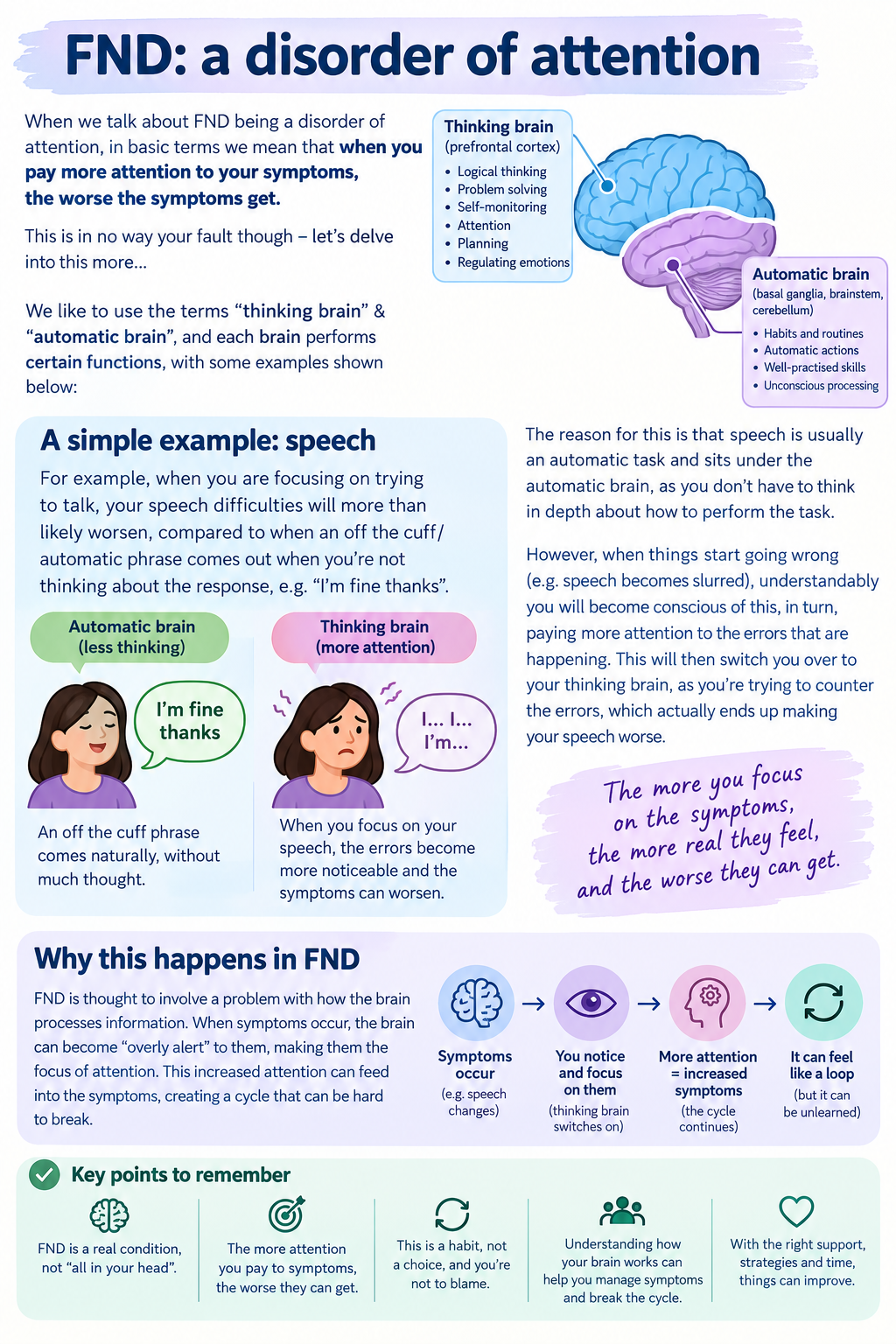
When we describe Functional Neurological Disorder (FND) as a “disorder of attention,” we are talking about the way attention can influence symptoms. In simple terms, when we become highly focused on a symptom, that symptom can become more noticeable and, for some people, more difficult to control.
This is not your fault. You are not consciously making your symptoms worse, and it does not mean that your symptoms are imagined or “all in your head.” The symptoms are real. Rather, it is about how the brain is processing and responding to what is happening.
To help explain this, it can be useful to think about the difference between the “thinking brain” and the “automatic brain.” These are simplified terms rather than two completely separate parts of the brain. They help us understand the difference between things we have to consciously think about and things our brain normally does automatically.
The thinking brain and the automatic brain
Our brains carry out thousands of tasks without us having to consciously think through every step. Walking, talking, typing, swallowing and many other familiar activities can become highly practised and largely automatic.
The thinking brain becomes more involved when we deliberately concentrate on something, analyse what is happening, solve a problem or try to consciously control a movement or action.
The automatic brain helps us carry out familiar, well-practised actions without needing to consciously plan every individual step.
Normally, this works extremely well. We don't have to think about every movement involved in speaking a sentence—we simply speak.
A simple example: speech
Imagine that you are having difficulty speaking and your speech has become slurred or hesitant.
Understandably, you may start to listen very carefully to every word you are saying. You might think:
“Am I saying this correctly?”
“Is my speech slurring?”
“I need to make sure I say this word properly.”
Your attention has now shifted towards the process of speaking.
Instead of allowing speech to happen as an automatic, well-practised activity, you are consciously monitoring and trying to correct it. This increased attention can sometimes interfere with the automatic process, making the speech difficulties more noticeable or pronounced.
This can help explain why someone might struggle when deliberately trying to say something, but then suddenly produce a familiar phrase quite naturally—for example:
“I'm fine, thanks.”
The phrase may come out more easily because the person isn't consciously analysing how each word is being produced.
How the cycle can develop
This can create a frustrating cycle:
A symptom occurs → you notice it → you become concerned about it → you focus more attention on it → the symptom becomes more noticeable or difficult → you focus on it even more.
It is completely understandable that this happens. If something is frightening, uncomfortable or unfamiliar, our natural response is often to monitor it more closely.
The important thing is that this cycle is not something you are choosing to create.
Understanding the relationship between attention and symptoms can simply give you another way of understanding what is happening. For some people, learning to reduce excessive monitoring of symptoms and allowing familiar activities to become more automatic again can form part of their management and rehabilitation.
FND symptoms are real. Understanding how attention can influence them does not make them any less real.